Fallen leaves and other leaf residues are widely available in agricultural areas, gardens, parks, and municipal green-waste collection systems. Instead of leaving this material loose, it can be processed into compact biomass pellets for easier handling and storage.
A leaf pellet mill is the core forming equipment, but successful production depends on proper raw material preparation, moisture control, grinding, and post-pelletizing treatment.
Preparing Leaf Residues
Leaves are naturally light and have a relatively low bulk density. They can also contain soil, stones, branches, plastic, and other foreign materials when collected from outdoor areas.
The first step is therefore to clean and sort the raw material.
Removing hard foreign materials helps protect the processing equipment and improves the quality of the finished pellets.
After cleaning, the leaves may need to be shredded or crushed before entering the fine grinding stage.
Moisture Control
Moisture has a direct effect on pellet formation.
Fresh or recently collected leaves can contain considerable moisture, while dry leaves may already be close to a suitable condition for pelletizing.
When the material is too wet, a drying system can reduce the moisture before grinding or pelletizing. A rotary dryer can be used for continuous processing when the project requires larger throughput.
However, not every leaf pellet project needs a dryer. The actual requirement should be determined by testing the available material.
Grinding the Leaves
Dry leaves can be difficult to feed consistently when they are still in large pieces.
A hammer mill can reduce the prepared material to a more uniform particle size. This helps create a more consistent feedstock for the pellet mill.
The grinding capacity should be matched with the required pellet production capacity.
If the grinder cannot provide enough material, it can become a bottleneck even when the pelletizing machine has sufficient capacity.
Pelletizing Process
After preparation, the leaves are transferred to the pelletizing section.
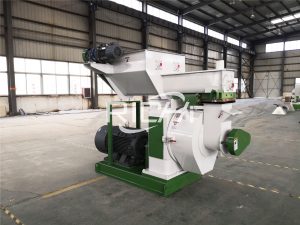
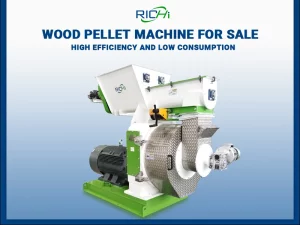
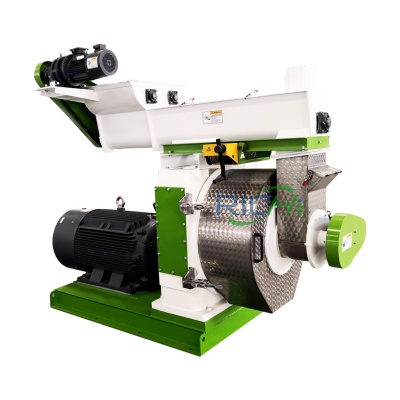
Inside the machine, rollers compress the biomass against a die. The material is forced through the die openings and forms cylindrical pellets.
The pellet diameter depends mainly on the selected die, while production performance is influenced by moisture, particle size, raw material characteristics, and operating conditions.
For other agricultural residues, a 5T/H grass pellet machine for sale may also be considered when designing a forage or biomass pellet project. However, leaves and grass have different physical properties, so the final equipment configuration should be based on the actual feedstock.
Cooling and Screening
Fresh biomass pellets normally leave the pellet mill with heat generated during compression.
A cooler can reduce their temperature before storage and improve handling stability.
The pellets can then pass through a screening machine. Loose fines and undersized particles are separated from the finished product.
Depending on the production system, suitable fines can be returned to the pelletizing section.
This helps maintain a more consistent finished product and reduce material loss.
Typical Leaf Pellet Production Flow
A basic production process can be arranged as:
Leaf collection → cleaning → crushing or shredding → drying when necessary → grinding → pelletizing → cooling → screening → storage
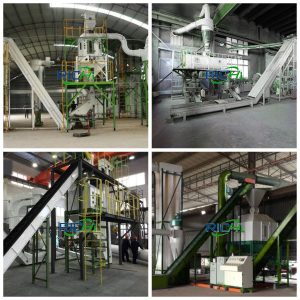
A complete pellet production line can connect these stages through conveyors and automatic feeding equipment.
The exact configuration depends on the source of the leaves, their moisture content, contamination level, and required production capacity.
Equipment Configuration
A commercial leaf pellet project may include:
- Raw material receiving system
- Cleaning or sorting equipment
- Crusher or shredder
- Hammer mill
- Dryer when required
- Pellet mill
- Pellet cooler
- Vibrating screen
- Conveyors
- Storage or packing equipment
Smaller projects may use a simpler configuration if the leaves are already clean, dry, and properly sized.
Applications of Leaf Pellets
Leaf pellets can be considered for biomass fuel applications where their physical and fuel properties meet the requirements of the intended heating system.
Pelletizing increases the bulk density of loose leaves and produces a more standardized material.
The actual calorific value and combustion characteristics depend on the type of leaves, moisture content, contamination, and production conditions.
Testing the finished pellets is recommended before selecting a specific end-use system.
Planning Before Investment
Before purchasing equipment, project owners should determine:
- Daily leaf availability
- Moisture content
- Foreign-material content
- Required production capacity
- Target pellet diameter
- Existing preparation equipment
- Available heat source
- Storage requirements
- Packaging method
These details help determine whether the project requires cleaning, drying, grinding, cooling, or additional material-handling equipment.
A leaf pellet project should therefore be designed as an integrated processing system rather than simply purchasing a pellet mill. Proper preparation and moisture control are just as important as the pelletizing stage.
For more information about biomass pellet equipment and processing solutions, read more.
Related Post: https://pelletizerequipment.com/hemp-pellet-machine/