Cattle feed is one of the largest operating expenses for many livestock farms and commercial feed manufacturers. The cost of corn, soybean meal, forage, bran, minerals, additives, energy, labor, transportation, and equipment maintenance can all influence the final cost of feed. As feed production becomes more competitive, simply purchasing cheaper raw materials is no longer enough. Modern cattle feed production technology provides a more systematic way to reduce costs while maintaining consistent feed quality.
Modern technology can improve almost every stage of cattle feed production, from raw material receiving and grinding to batching, mixing, conditioning, pelletizing, cooling, screening, packaging, and storage. Better process control helps reduce material losses, improve nutrient distribution, lower energy consumption, reduce labor requirements, and increase equipment utilization.
A properly designed production line can also make better use of agricultural by-products and high-fiber materials. When combined with accurate formulation and an efficient pelletizing process, these improvements can significantly influence the overall economics of cattle feed production.
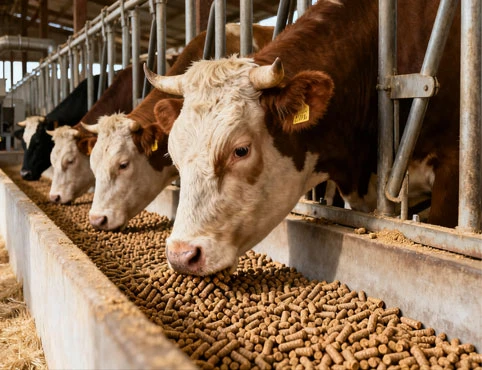
One important piece of equipment in this process is the pellet making machine for cattle feed. A well-selected pellet machine can convert properly prepared feed mixtures into uniform pellets, improve handling efficiency, reduce separation during transportation, and support more consistent feeding.
1. Why Cattle Feed Costs Are So Important
The cost of cattle feed depends on much more than the price of individual ingredients.
A commercial feed producer must consider:
- Raw material purchase costs
- Transportation and unloading
- Storage losses
- Grinding energy
- Batching and mixing labor
- Steam and electricity consumption
- Pelletizing costs
- Cooling and screening
- Packaging
- Equipment maintenance
- Labor requirements
- Product losses
- Warehouse management
- Feed quality losses
For livestock farms, feed efficiency also matters. A low-cost feed is not necessarily economical if its nutrients are poorly distributed or if excessive fines, moisture problems, or ingredient separation reduce its practical feeding value.
Modern production technology therefore focuses on total production cost rather than simply raw material price.
The goal is to produce consistent feed with the required nutritional characteristics while using raw materials, energy, labor, and equipment as efficiently as possible.
2. Better Feed Formulation Reduces Raw Material Costs
Feed formulation is one of the first areas where technology can reduce cattle feed costs.
Traditional feed formulation may depend heavily on manual calculations and fixed recipes. Modern feed mills can use formulation software to calculate ingredient combinations according to nutritional requirements, ingredient prices, and available raw materials.
For example, a cattle feed formula may include:
- Corn
- Barley
- Wheat bran
- Soybean meal
- Cottonseed meal
- Alfalfa
- Grass hay
- Straw
- Molasses
- Mineral additives
- Vitamin premixes
The exact formula depends on cattle type, growth stage, production target, local ingredient availability, and nutritional requirements.
Modern formulation systems can compare different ingredient combinations and identify practical alternatives when certain raw materials become expensive.
This does not mean simply replacing expensive ingredients with cheaper ones. The replacement must still satisfy nutritional requirements.
By using formulation technology, producers can reduce unnecessary over-formulation and make more efficient use of available ingredients.
3. Accurate Batching Reduces Ingredient Waste
Incorrect ingredient quantities can increase production costs and affect feed quality.
Manual batching can introduce errors, particularly when a feed formula contains many ingredients or small quantities of additives.
Modern automatic batching systems use weighing equipment and programmed formulas to control ingredient quantities more accurately.
The system can automatically:
- Select the correct formula.
- Control the feeding sequence.
- Weigh individual ingredients.
- Record the actual quantity.
- Send materials to the next processing stage.
Accurate batching reduces overuse of expensive ingredients such as soybean meal, minerals, vitamins, and additives.
It also improves formula consistency from one batch to another.
For large cattle feed plants, this can create substantial savings because even a small percentage of material overuse can become significant when production reaches several tons per hour.
4. Efficient Grinding Lowers Energy Consumption
Grinding is necessary for many cattle feed formulas because reducing particle size improves mixing and can support subsequent pellet production.
However, grinding can consume considerable electrical energy.
Modern hammer mills and other grinding systems can improve energy efficiency through:
- Optimized grinding chambers
- Appropriate screen selection
- Efficient rotor design
- Stable material feeding
- Variable-frequency control
- Better airflow management
- Automatic load monitoring
The goal is not to grind every material as finely as possible.
Excessive grinding consumes additional energy and may not provide additional benefits for every formula. The appropriate particle size should depend on the ingredients, cattle feed formulation, pellet diameter, and production process.
A correctly configured grinding system therefore helps balance feed quality and energy consumption.
5. Better Mixing Improves Nutrient Utilization
Mixing is another critical stage in cattle feed production.
If ingredients are not distributed evenly, one portion of feed may contain more protein or minerals than another. This can reduce product consistency and increase the risk of nutrient imbalance.
Modern feed mixers are designed to provide more uniform ingredient distribution.
Depending on the production line, the mixer may also handle liquid ingredients such as molasses, oil, or other additives.
A well-designed mixing system can reduce:
- Mixing time
- Ingredient separation
- Manual intervention
- Batch-to-batch variation
- Product losses
Better mixing also supports the efficient use of expensive nutritional ingredients because they can be distributed more evenly throughout the feed.
6. Pelletizing Can Improve Material Handling Efficiency
Pelletizing is one of the most important technologies used in modern cattle feed production.
A pellet making machine for cattle feed compresses prepared feed material through a die to produce compact pellets of a specified diameter.
Pellet production can provide several practical advantages.
Pellets are easier to transport, store, handle, and distribute than loose mixtures. They can also reduce the separation of different ingredients that may occur in a loose feed mixture.
A properly designed pelletizing system can therefore contribute to lower handling and distribution costs.
Pelletizing also makes it easier to produce standardized feed products for different categories of cattle.
Depending on the formula and feeding requirements, producers may manufacture different pellet sizes for calves, growing cattle, beef cattle, or dairy cattle.
7. Choosing the Right Pellet Making Machine for Cattle Feed
Not every pellet machine is suitable for every cattle feed formula.
The correct machine should be selected according to:
- Production capacity
- Feed formula
- Fiber content
- Moisture content
- Pellet diameter
- Required output
- Die compression ratio
- Raw material characteristics
- Automation level
- Operating schedule
A pellet making machine for cattle feed should be capable of handling the intended formula continuously and efficiently.
For high-fiber cattle feed, the pellet mill needs sufficient compression performance and a suitable die configuration. Roughage-based formulas can behave differently from concentrate feeds because fibers affect material flow, compression, and pellet formation.
Selecting a machine that is too small may create a production bottleneck. Selecting an excessively large machine can increase initial investment and reduce equipment utilization.
Correct capacity matching is therefore an important part of controlling long-term feed production costs.
(Learn more: https://richipelletizer.com/cattle-feed-pellet-mill-for-sale/)
8. Steam Conditioning Improves Pelletizing Efficiency
Modern cattle feed pellet production often uses steam conditioning before pelletizing.
During conditioning, steam increases the temperature and moisture of the feed mixture. This can improve material preparation before compression and may support better pellet formation.
Proper conditioning can contribute to:
- Improved pellet quality
- Better material flow
- Reduced fines
- More stable pelletizing
- Improved production efficiency
- Potentially lower mechanical load
The exact conditioning requirements depend on the feed formula.
High-fiber cattle feed, grain-based feed, and formulas containing different levels of molasses or other ingredients may require different process settings.
Modern control systems can help operators monitor steam addition and conditioning parameters more consistently.
9. Better Pellet Quality Reduces Product Loss
Poor pellet quality can create additional costs.
If pellets break easily, excessive fines may appear during cooling, screening, transportation, and packaging.
These fines may need to be recycled or handled separately.
Modern pellet production technology aims to produce pellets with suitable durability and uniformity.
Several factors affect pellet quality:
- Raw material particle size
- Moisture
- Formula composition
- Conditioning
- Die compression ratio
- Pellet mill operating parameters
- Roller condition
- Cooling
- Screening
A stable process can reduce the amount of material that needs to be recycled.
This improves the effective yield of the production line and helps reduce unnecessary material handling.
10. Automatic Cooling Reduces Post-Pellet Losses
Fresh pellets leave the pellet mill at elevated temperature and often contain more moisture than the final storage specification.
They need to be cooled and stabilized before packaging or storage.
Modern counterflow or other industrial pellet coolers use controlled airflow to reduce pellet temperature and moisture.
Efficient cooling can help prevent:
- Mold growth
- Condensation
- Pellet deterioration
- Excessive fines
- Storage losses
Cooling efficiency is particularly important for large-scale feed production because poorly cooled pellets can create problems throughout the storage and distribution system.
11. Screening Helps Recover Usable Material
Screening is often used after cooling.
A vibrating screen or other screening system separates finished pellets from fines and oversized or unwanted particles.
The separated fines can often be returned to the production process, depending on the plant design and feed formula.
This creates a recycling loop that can improve material utilization.
Instead of treating fines as waste, modern production systems can incorporate them back into the process.
Effective screening therefore helps improve final product consistency while reducing unnecessary material loss.
12. Automation Reduces Labor Costs
Labor is another important component of cattle feed production costs.
A traditional feed plant may require operators to manually control several stages of production.
Modern automated systems can integrate:
- Raw material conveying
- Batching
- Grinding
- Mixing
- Conditioning
- Pelletizing
- Cooling
- Screening
- Packaging
Centralized control systems allow operators to monitor equipment status and production parameters from a control room.
Automation does not necessarily eliminate the need for skilled workers. Instead, it allows fewer operators to manage more equipment while reducing repetitive manual tasks.
It can also reduce human errors during formula changes and production operations.
13. Variable Frequency Drives Improve Energy Efficiency
Variable-frequency drives, or VFDs, can be used on selected motors throughout a feed production line.
Instead of always operating at maximum speed, equipment can adjust its operating speed according to production requirements.
VFDs may be applied to:
- Feeders
- Conveyors
- Fans
- Mixers
- Pellet mill auxiliary systems
- Cooling systems
- Other motor-driven equipment
When properly configured, speed control can reduce unnecessary electricity consumption and improve process stability.
Energy savings become increasingly important as feed plants operate for many hours per day.
14. Automatic Lubrication and Maintenance Reduce Downtime
Unexpected equipment failure can be expensive.
A production line may lose both production time and labor when a critical machine stops.
Modern equipment can incorporate automatic lubrication systems and condition monitoring features.
For a pellet mill, regular maintenance of the die, rollers, bearings, gearbox, lubrication system, and drive components is particularly important.
A preventive maintenance program helps identify problems before they become major failures.
This can reduce:
- Emergency repair costs
- Production downtime
- Spare-part consumption
- Labor costs
- Production interruptions
Maintenance is therefore not only a technical issue. It is also an important cost-control strategy.
15. Modern Technology Makes Better Use of Agricultural By-Products
One advantage of advanced cattle feed production systems is the ability to process a wider range of agricultural materials.
Depending on nutritional requirements and formula design, cattle feed may incorporate suitable by-products such as:
- Wheat bran
- Rice bran
- Corn by-products
- Brewery by-products
- Oilseed meals
- Sugar processing by-products
- Agricultural forage
- Certain processed crop residues
Using locally available by-products can reduce dependence on more expensive conventional ingredients.
However, each material must be evaluated for nutritional value, moisture, contamination risk, particle size, storage characteristics, and suitability for the intended cattle feed.
Modern processing equipment makes it easier to prepare and incorporate these materials into consistent feed formulas.
16. Moisture Control Helps Reduce Storage Costs
Moisture has a direct influence on cattle feed stability.
Excess moisture can increase the risk of microbial growth and deterioration, while excessively dry material can affect processing performance and increase dust.
Modern feed production systems use controlled drying, conditioning, cooling, and storage processes to maintain appropriate moisture levels.
Sensors and process controls can help operators monitor conditions at important stages.
Better moisture control reduces product losses and improves storage reliability.
17. Digital Monitoring Improves Production Management
Modern cattle feed plants increasingly use digital monitoring systems.
Production data can include:
- Raw material consumption
- Production output
- Electricity consumption
- Equipment operating time
- Batch records
- Formula information
- Alarm history
- Maintenance records
This information allows managers to identify production bottlenecks and unusual consumption.
For example, if electricity consumption increases while production output remains unchanged, the plant manager can investigate possible problems with grinding, pelletizing, motors, or other equipment.
Data-driven management can therefore help reduce hidden operating costs.
18. Better Factory Layout Reduces Conveying Costs
Plant layout also influences production economics.
An inefficient layout may require excessive conveyors, elevators, transfer points, and material movement.
A well-designed cattle feed plant creates a logical material flow from raw material receiving to finished product packaging.
A typical process may include:
Raw Material Receiving → Cleaning → Crushing → Batching → Mixing → Conditioning → Pelletizing → Cooling → Screening → Packaging
The exact process depends on the feed formula and production requirements.
Reducing unnecessary material movement can lower energy consumption, equipment investment, maintenance requirements, and production losses.
19. Packaging Technology Reduces Labor and Material Waste
Packaging is often overlooked when calculating cattle feed production costs.
Manual bagging can require significant labor and may result in inconsistent bag weights.
Automatic weighing and packing systems can provide more consistent packaging while reducing repetitive manual work.
Modern systems may integrate:
- Automatic weighing
- Bag filling
- Bag clamping
- Sewing or sealing
- Bag conveying
- Palletizing
For commercial feed manufacturers, consistent packaging can also improve inventory management and product handling.
20. How Technology Helps Different Types of Cattle Feed
Modern production technology can be adapted to different cattle feed categories.
Dairy Cattle Feed
Dairy feed may require precise nutritional management because energy, protein, fiber, minerals, and other components need to be balanced according to production goals.
Accurate batching and mixing are particularly important.
Beef Cattle Feed
Beef cattle feed may include grains, protein meals, forage, and other ingredients.
Pelletizing can make the final feed easier to handle and distribute.
Calf Feed
Calf feed may require smaller pellet sizes and carefully controlled formulas.
Accurate processing technology helps maintain consistent product characteristics.
High-Fiber Feed
High-fiber formulas require suitable grinding, conditioning, and pelletizing equipment.
The pellet mill must be selected according to the characteristics of the raw materials.
21. Reducing Costs Does Not Mean Choosing the Cheapest Equipment
One of the most common mistakes in feed plant investment is focusing only on equipment purchase price.
A cheaper machine may have:
- Lower production capacity
- Higher energy consumption
- More frequent maintenance
- Shorter component life
- More manual operation
- Poorer pellet quality
- Higher downtime
The actual cost of a machine should therefore be evaluated over its operating life.
Important factors include:
Initial investment + energy consumption + labor + maintenance + spare parts + downtime + production losses
A higher-quality production system may have a higher initial investment but provide better operating economics over many years.
(Learn about high-performance cattle feed pellet machine price)
22. Complete Production Line Design Can Reduce Overall Costs
Equipment should not be considered separately.
A high-capacity pellet mill cannot compensate for an undersized grinder, mixer, cooler, or conveying system.
For example, if the pellet mill can process 10 tons per hour but the cooler can only handle 6 tons per hour, the cooler becomes the bottleneck.
A complete production line should therefore be balanced according to the target capacity.
A turnkey feed plant can integrate:
- Raw material receiving
- Cleaning
- Grinding
- Batching
- Mixing
- Conditioning
- Pelletizing
- Cooling
- Screening
- Packaging
- Electrical control
- Material conveying
This integrated approach can reduce bottlenecks and improve overall equipment utilization.
23. How RICHI Helps Reduce Cattle Feed Production Costs
RICHI Pelletizer can design cattle feed production systems according to raw materials, feed formulas, target capacity, pellet size, factory conditions, and automation requirements.
Instead of focusing on one machine alone, the production process can be considered as a complete system.
For example, a cattle feed line may include a grinder, batching system, mixer, conditioner, pellet making machine for cattle feed, cooler, vibrating screen, conveyors, and automatic packing equipment.
The equipment configuration can be adjusted according to whether the customer produces concentrate feed, roughage feed, or formulas containing higher levels of fiber.
A properly engineered line can help improve material utilization, production stability, labor efficiency, and equipment coordination.
24. Practical Ways to Reduce Cattle Feed Costs
A feed producer can evaluate the following areas:
- Review the feed formula regularly.
- Use locally available suitable raw materials.
- Improve batching accuracy.
- Optimize grinding particle size.
- Improve mixing uniformity.
- Control steam conditioning.
- Select the appropriate pellet mill.
- Maintain dies and rollers properly.
- Improve pellet cooling.
- Recycle suitable fines.
- Reduce unnecessary material movement.
- Automate repetitive processes.
- Monitor electricity consumption.
- Establish preventive maintenance.
- Train operators properly.
- Improve warehouse management.
- Reduce packaging losses.
- Monitor production data.
- Balance the capacity of every machine.
- Plan the production line for future expansion.
These measures can work together to reduce total production costs without relying on a single technology.
25. What to Consider When Investing in Modern Cattle Feed Technology
Before investing in a cattle feed production line, manufacturers should define several key parameters.
Raw Materials
Identify all major ingredients and their moisture, fiber, density, and particle-size characteristics.
Feed Formula
Different formulas require different processing conditions.
Capacity
Determine current production requirements and possible future expansion.
Pellet Size
Define the required pellet diameter according to the target cattle and product specifications.
Automation
Decide whether the plant should be manual, semi-automatic, or highly automated.
Factory Space
The available building area affects equipment arrangement and material flow.
Energy Supply
Electricity and steam availability should be considered during equipment selection.
Maintenance
Check spare-part availability, maintenance requirements, and technical support.
Equipment Integration
Ensure that the grinder, mixer, pellet mill, cooler, screen, conveyor, and packing system are properly matched.
A professional supplier can use this information to design a production system around the actual operating conditions rather than simply providing a standard equipment list.
26. The Long-Term Economic Value of Modern Feed Technology
The value of modern technology should be measured over the entire operating life of a feed plant.
The initial investment is only one part of the equation.
Long-term economic performance depends on:
- Production capacity
- Product yield
- Energy efficiency
- Labor requirements
- Pellet quality
- Maintenance frequency
- Spare-part costs
- Equipment durability
- Downtime
- Raw material utilization
A production line that consistently produces high-quality feed with controlled operating costs can provide better long-term economic performance than a system selected only for its low purchase price.
Modern cattle feed technology therefore represents more than automation or advanced machinery. It is an integrated approach to controlling the entire production process.
Conclusion
Modern technology can reduce cattle feed costs by improving the efficiency of almost every stage of production. Better formulation systems can optimize ingredient use, accurate batching can reduce overuse, efficient grinding can control energy consumption, and advanced mixing can improve nutrient distribution.
Conditioning and pelletizing technologies can improve production stability, while a properly selected pellet making machine for cattle feed can produce uniform pellets that are easier to handle, transport, store, and distribute. Cooling and screening systems can further reduce product losses, while automation and digital monitoring can lower labor requirements and improve production management.
However, cost reduction should not be based on choosing the cheapest machine. The most important consideration is the total operating economics of the complete production system.
By combining appropriate raw materials, accurate formulation, efficient processing equipment, balanced production-line design, automation, preventive maintenance, and professional technical support, cattle feed manufacturers can build a more efficient and controllable production process.
For businesses planning a new cattle feed plant or upgrading an existing facility, modern technology provides opportunities to reduce waste, improve equipment utilization, control energy consumption, and maintain consistent feed quality. The right solution is ultimately the one that matches the feed formula, production capacity, raw materials, pellet specifications, factory conditions, and long-term operating goals.