If you spend any time watching your goats eat, you start to notice things. They don’t just eat. They sort. They nuzzle through the feed, picking out the bits they like and leaving the rest behind. They toss their heads, scattering pellets and dust. They step on feed, soil it, and refuse to touch it again. By the time they’re done, a surprising amount of what you paid for is on the ground, in the bedding, or simply ignored.
That’s not just messy. It’s expensive. Feed is the largest recurring cost on most goat operations. When a significant portion of it never actually makes it into the animal, you’re not just losing feed. You’re losing the money you spent on it, the time you spent handling it, and the production you expected from it. Milk yields drop. Growth slows. The herd doesn’t perform the way it should.
The good news is that this is a solvable problem. The solution isn’t a more complicated feeding schedule or a more expensive commercial ration. It’s a different physical form of feed. Pellets.
Why Goats Are Picky (and Why It Costs You)
Goats are browsers by nature. They evolved to wander through scrub and woodland, sampling leaves, shoots, and bark. They have a natural instinct to investigate their food, to choose the best bits, and to leave the rest. In a wild setting, that instinct serves them well. In a feed trough, it works against you.
When you offer loose mash or unprocessed grain, goats can separate the ingredients. They’ll eat the corn and leave the mineral supplement. They’ll eat the sweet feed and leave the protein meal. They’ll eat the leaves and leave the stems. Every time they do that, they’re not getting a balanced ration. They’re getting a portion of what you intended, and they’re leaving the rest to waste.
Over time, that selective feeding leads to nutritional gaps. The goats that are eating mostly grain may be getting too much energy and not enough fiber. The ones eating mostly roughage may be getting too much fiber and not enough protein. The herd becomes uneven. Some animals thrive. Others struggle. And you’re left trying to figure out why.
The Case for Pellets
Pelleting solves the sorting problem. When feed is ground, mixed, and compressed into a pellet, every pellet contains the same proportion of every ingredient. The goat can’t pick out the corn because the corn is bound together with everything else. It can’t leave the minerals because the minerals are inside the pellet, not dusted on the outside.
That means every bite delivers a complete, balanced ration. The goat gets the protein, the energy, the fiber, and the minerals in the right proportions. There’s no waste from sorting. There’s no nutritional inconsistency from one animal to the next. The entire herd gets what it needs, every time.
Pelleted feed also reduces physical waste. Pellets are denser and heavier than mash. They don’t blow away in the wind. They don’t scatter as easily when the goats toss their heads. They don’t turn to dust at the bottom of the feeder. More of what you put in the trough actually gets eaten. And that alone can save you 10% to 20% on feed costs.
What Pelleting Does for Digestion
The benefits don’t stop at the feeder. Pelleting also changes the feed at a nutritional level. The heat and pressure of the pelleting process gelatinize starches and break down some of the fibrous structures. That makes the feed easier for the goat to digest. More of the nutrients are absorbed, and less passes through undigested.
For dairy goats, that can mean higher milk production on the same amount of feed. For meat goats, it can mean faster growth and better feed conversion. For fiber goats, it can mean healthier coats and stronger fiber. The improvement varies by operation and by ration, but the direction is consistent. Better processing leads to better digestion, and better digestion leads to better performance.
Choosing the Right Machine
If you’re convinced that pelleting makes sense for your goats, the next question is equipment. Not all pellet machines are the same. Some are designed for wood pellets. Some are designed for poultry feed. Some are general-purpose machines that can handle a range of materials but don’t excel at any of them.
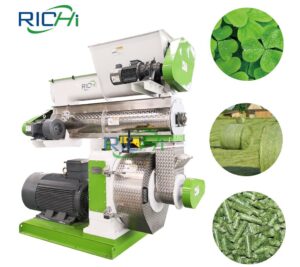
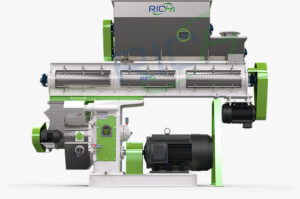
A goat feed making machine is designed specifically for the demands of small ruminant feed. It has the right die configuration to produce pellets of the right size and hardness. Goats prefer pellets that are firm but not rock-hard. They’ll reject pellets that are too hard to chew, and they’ll waste pellets that crumble into dust. The die and the conditioning system have to be matched to the ration.
The machine also has to handle the ingredients that go into goat feed. Goat rations often include fibrous ingredients like alfalfa meal, grass hay, and browse. These materials are more difficult to pellet than grains. They require more conditioning and a different die design. A machine that works well for chicken feed may struggle with goat feed. A machine that’s built for goat feed will handle it consistently.
Why Richi Pellet Machine Stands Out
When you start looking at equipment, you’ll find a lot of options. Some are cheap. Some are expensive. Some come from manufacturers with decades of experience. Some come from companies that seem to have appeared overnight. The difference matters, especially when you’re investing in a machine that you expect to run for years.
Richi Pellet Machine has been building feed processing equipment for a long time. They’ve worked with farmers and feed producers in many countries. They understand that goat feed is not the same as poultry feed or cattle feed. They know the challenges of pelleting fibrous rations. They’ve designed their machines to handle those challenges.
Their equipment is built for durability. The dies are made from wear-resistant alloys. The rollers are precision-machined. The bearings are sealed against dust and moisture. The motors are sized for continuous operation. The controls are straightforward enough for a farmer to operate but sophisticated enough to maintain consistent quality.
Just as importantly, they provide support. Installation guidance. Operator training. Spare parts. Technical assistance when something isn’t working right. That support can be the difference between a machine that runs smoothly for years and one that sits idle waiting for a part or an answer.
What to Look for in a Machine
If you’re evaluating goat feed making machines, there are several things to check. First, the capacity. How much feed do you need to produce per hour or per day? Match the machine to your herd size and your feeding schedule. Oversizing wastes money. Undersizing means you’re always playing catch-up.
Second, the die. What size pellets does it produce? Can you change the die to produce different sizes for different classes of goats? Is the die made from a material that will stand up to abrasive ingredients?
Third, the conditioning system. Does it provide enough steam to soften the fibers? Can you control the temperature and moisture? Proper conditioning is essential for durable pellets.
Fourth, the motor and drive. Is the motor sized for the load? Is the drive system robust enough for continuous operation? A machine that overheats or stalls under load will not last.
Fifth, the controls. Are they easy to understand and operate? Can you adjust parameters on the fly? Is there any automation to help maintain consistency?
Sixth, the manufacturer. Do they have experience with goat feed? Can they provide references? Do they offer support after the sale? A good manufacturer is a partner, not just a vendor.
The Economics of On-Farm Pelleting
The decision to buy a pellet machine is ultimately a financial one. The machine costs money. The installation costs money. The electricity and maintenance cost money. You need to know that the savings and the improved performance will justify the investment.
For most goat operations, the math works. If you’re spending $10,000 a year on feed and you can reduce waste by 15%, that’s $1,500 in savings. If pelleting improves feed conversion by 10%, that’s another $1,000 in savings. If it improves milk production or growth rates, the benefit is even larger. Over the life of the machine, those savings add up.
The payback period varies. For a small herd and a small machine, it might be two or three years. For a larger operation with a bigger machine, it might be faster. The key is to run the numbers for your own situation, using your own feed costs and your own performance data.
Getting Started
If you’re ready to explore pelleting for your goats, the first step is to talk to a manufacturer who understands the application. Explain your herd size, your current feeding program, and your goals. Ask for a recommendation on machine size and configuration. Ask for references from other goat farmers. Ask about training and support.
The second step is to visit an installation if you can. See the machine in operation. Talk to the operator. Watch how the pellets come out. Ask about maintenance and downtime. A firsthand look will tell you more than any brochure.
The third step is to run a trial. If possible, process a batch of your own feed on a demonstration machine. See how the goats respond. Compare the waste and the performance to what you’re seeing now. A small trial can give you confidence before you make a full commitment.
The Bottom Line
Your goats are going to eat. That’s not going to change. What can change is how much of what you feed them actually gets used. Pelleting is the most effective way to reduce waste, improve consistency, and get more value from every pound of feed. The right machine makes it possible. The right partner makes it easier.
If you’re tired of watching your feed bill climb while your goats sort through their rations, it’s time to consider a different approach. click now to learn more about goat feed making machines and how they can transform your operation. The technology is proven. The benefits are real. And the first step is just a click away.