
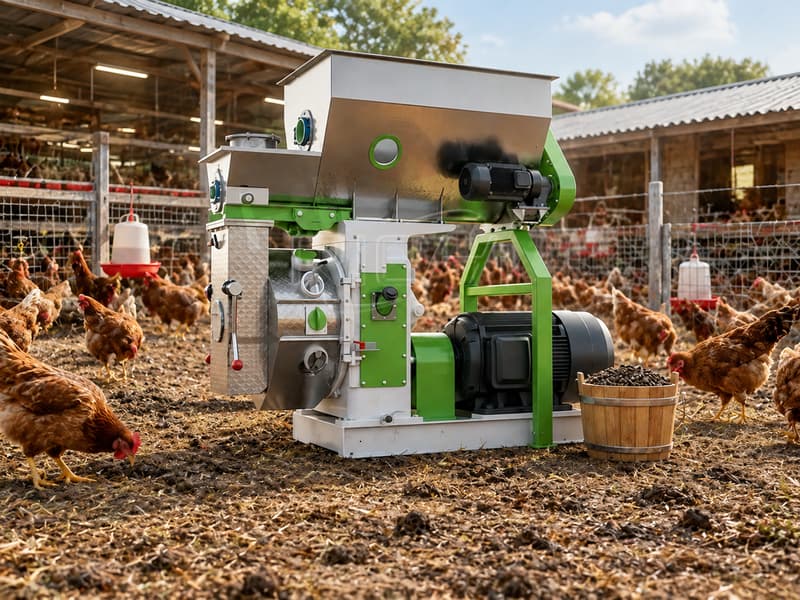
Poultry farms generate organic material every day, but turning that material into a commercial fertilizer requires more than simply installing a granulator.
A professional processing facility must solve several practical challenges at once. These include handling wet feedstock, stabilizing organic material, maintaining uniform moisture, creating a consistent particle size, and delivering a finished product that can be stored and transported efficiently.
For companies considering a poultry manure fertilizer project, the production line should be designed around these challenges.
Start with the Material, Not the Equipment Catalogue
No two manure sources are exactly the same.
The physical characteristics of poultry manure can change according to poultry type, housing systems, bedding materials, collection methods, storage time, and weather conditions.
One batch may be relatively dry and free-flowing, while another may contain more moisture and form sticky clumps.
This means equipment selection based only on the raw-material name “chicken manure” is not enough.
A proper project assessment should consider the actual material that will enter the plant.
Why Pretreatment Has Such a Large Impact
A fertilizer factory can only produce consistent granules when the incoming feedstock is reasonably consistent.
Pretreatment may include composting, drying, crushing, screening, or a combination of these steps.
The purpose is to transform irregular manure into a material with more predictable physical properties.
This improves the conditions for downstream mixing and granulation.
In larger projects, pretreatment also helps isolate different process functions. The composting section handles biological stabilization, the dryer manages moisture, the crusher prepares particle size, and the mixer creates formulation uniformity.
Separating these functions can make the production system easier to manage.
The Importance of Controlled Particle Size
Large lumps are difficult to mix evenly.
They can also interfere with continuous feeding and create inconsistent granules.
For this reason, a crusher is often installed before the mixer and granulation stage.
The goal is not always to create extremely fine powder. Instead, the material should be reduced to a condition appropriate for the selected pelletizing process.
The required particle size can vary according to the manure characteristics and fertilizer formula.
Over-processing the raw material can consume unnecessary energy, so the crushing stage should be designed with the actual production requirements in mind.
The Granulation Stage
Once the feed material is prepared, it enters the key forming stage.
A poultry manure pellet machine compresses the conditioned material into regular fertilizer particles.
The pelletizing mechanism determines how the material is compacted and shaped.
For commercial operations, the key objective is generally consistency. A factory needs to produce granules that remain reasonably uniform from batch to batch.
The correct machine configuration depends on the material properties, formulation, production capacity, and target granule size.
This is why the granulator should be selected only after upstream conditions are established.
What Happens If the Moisture Is Wrong?
Moisture affects almost every stage of the production process.
Too much moisture can increase stickiness and make drying more demanding.
Insufficient moisture may affect the material’s ability to form stable granules.
Moisture also influences cooling, screening, storage, and packaging.
Therefore, operators should not treat the dryer as a machine that simply removes as much water as possible.
The target is controlled moisture suitable for the next production step.
This approach can improve stability and avoid unnecessary energy use.
Designing Around a 3-4 T/H Project
Medium-scale fertilizer plants often need a balance between automation and flexibility.
A project evaluating a 3-4 T/H organic fertilizer pellet machine for sale may involve a commercial producer serving regional agricultural customers.
At this scale, the plant may require continuous conveying between several processing stages.
A typical configuration could include a feeding system, dryer, crusher, mixer, pelletizing section, cooler, screening machine, and finished-product packaging system.
However, the actual design should still be based on material testing.
A nominal output is only meaningful when the machine receives feedstock within its intended operating range.
Cooling Is Part of Product Quality
Granulation does not necessarily mean the product is immediately ready for packaging.
Fresh granules may require cooling and stabilization before entering the storage or bagging section.
A cooler lowers product temperature and can help create conditions that are more suitable for subsequent handling.
This becomes increasingly important as production capacity grows.
A good plant layout therefore treats cooling as an integral part of the process rather than an optional accessory.
Screening Creates a More Uniform Product Stream
A screening machine separates particles according to size.
Large particles can be removed for reprocessing, while undersized material can also return to the production cycle depending on the process design.
The result is a more uniform finished product.
This is particularly useful when the fertilizer will be sold under a standardized specification.
The screening stage also provides operators with useful feedback. If the proportion of oversize or undersize particles suddenly increases, it may indicate a change in moisture, formulation, machine settings, or raw-material condition.
What About Fertilizer Formulation?
Poultry manure does not necessarily have to be processed as a single-material product.
Some producers may combine it with other organic materials to develop different fertilizer formulations.
The exact recipe depends on the product objective and applicable local regulations.
When multiple materials are involved, the mixing system becomes even more important.
Uniform mixing helps ensure that each portion of material entering the granulator contains a similar composition.
A well-designed feeding and dosing system can therefore be as important to final consistency as the granulation machine itself.
Why Plant Layout Matters
A production line can have technically suitable machines and still be difficult to operate if the layout is poorly designed.
Material should move logically from one stage to the next.
Excessive transfer distance can increase energy consumption and complicate maintenance.
Operators also need sufficient access around key machines.
Maintenance areas, inspection points, electrical cabinets, dust-collection components, and spare-parts access should be considered before installation.
(Related Post:https://www.richipelletmill.com/organic-fertilizer-production-line/)
A compact layout is useful, but compact should not mean difficult to service.
Turning Production Data into Better Decisions
A mature fertilizer operation should track more than total output.
Operators can monitor moisture before and after drying, granule size distribution, machine load, production rate, energy consumption, and reprocessing volume.
These measurements provide insight into whether the plant is working within its intended range.
For example, a sudden rise in undersized particles may suggest a change in feed moisture or formulation.
Data can therefore help operators identify process changes before they become major production problems.
What Should Buyers Ask Before Installation?
A prospective buyer should prepare clear answers about:
Raw-material source
Daily supply
Average moisture
Desired capacity
Final pellet size
Fertilizer formulation
Operating hours
Available floor space
Packaging requirements
Power supply
The more precise this information is, the easier it becomes to build a practical equipment configuration.
A supplier may also use pilot testing or sample processing to verify how the manure behaves.
That is especially helpful when the feedstock is unusual or highly variable.
The Long-Term Value of a Pellet Plant
A manure fertilizer project should not be viewed only as a waste-treatment facility.
With suitable process design, it can become a manufacturing operation capable of producing a standardized agricultural input.
That distinction matters.
Waste handling focuses on removal.
Product manufacturing focuses on repeatability, quality control, customer requirements, packaging, and distribution.
Once a facility adopts the second perspective, many equipment decisions become clearer.
The dryer is no longer just a moisture-removal device. The mixer is not just a blending machine. The cooler and screen are not secondary equipment. Each plays a role in the commercial product.
A modern pellet plant should therefore be evaluated as one connected system.
Conclusion
Converting poultry manure into fertilizer granules requires a thoughtful balance between biological treatment, mechanical processing, and product design.
The key stages are often easy to describe, but the details determine whether the plant works efficiently in everyday operation.
Raw-material testing, moisture control, particle preparation, accurate mixing, appropriate granulation, cooling, screening, and packaging all contribute to a reliable production process.
For investors and farm operators, the best approach is to begin with the material and market requirements, define the desired output, and then build the equipment configuration around those conditions.
That method creates a stronger foundation for a fertilizer production project and makes the final granules easier to manage from factory floor to agricultural field.


