In modern livestock agriculture, automation is no longer a luxury—it is quickly becoming a necessity. As rabbit farming shifts from small backyard operations to large-scale commercial production, the demand for consistent, efficient, and high-quality feed has increased significantly. One of the most important developments in this field is the automatic rabbit feed production line, a fully integrated system designed to produce uniform rabbit feed pellets with minimal human intervention.
But a common question among farmers and investors remains: Is an automatic rabbit feed production line really worth it?
To answer this, we need to look at cost, efficiency, product quality, labor savings, long-term profitability, and the role of key equipment such as the rabbit food pellet maker in the entire production system.
1. Understanding What an Automatic Rabbit Feed Production Line Is
An automatic rabbit feed production line is a complete industrial system that converts raw agricultural materials into finished rabbit feed pellets. Unlike manual or semi-automatic systems, it uses automation technology to control almost every stage of production.
A typical system includes:
- Raw material storage and conveying system
- Grinding (hammer mill) system
- Mixing system
- Conditioning system
- Pelletizing system (rabbit food pellet maker)
- Drying system
- Cooling system
- Screening system
- Packaging system
All these components work together continuously, forming a streamlined production workflow.
The key idea is simple: reduce human labor, increase consistency, and maximize production efficiency.
2. Why Rabbit Feed Production Requires Precision
Rabbit nutrition is highly sensitive compared to other livestock animals. Rabbits require:
- High fiber content
- Balanced protein levels
- Controlled starch intake
- Clean and dust-free feed
If feed quality is inconsistent, rabbits may experience:
- Digestive disorders
- Reduced growth rate
- Poor reproduction performance
- High mortality rates in young rabbits
This is why the rabbit food pellet maker and automated systems play such a critical role in modern feed production.
3. The Role of the Rabbit Food Pellet Maker
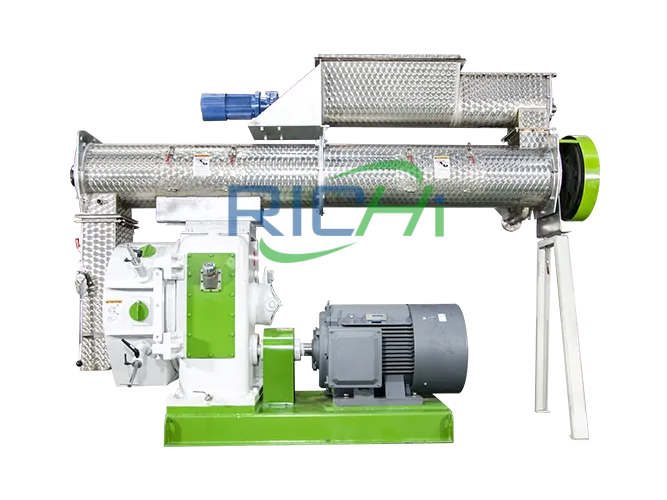
At the heart of every production line is the rabbit food pellet maker. This machine is responsible for turning powdered feed ingredients into compact, uniform pellets that rabbits can easily consume.
How it works:
- Prepared feed enters the pellet chamber
- Rollers press the material through a die
- High pressure and friction generate heat
- Material is compressed into solid pellets
- Pellets are cut to uniform length
Why it is essential:
- Ensures uniform feed size
- Improves digestibility
- Reduces feed waste
- Prevents selective feeding behavior
- Enhances storage stability
Without a reliable rabbit food pellet maker, even the best feed formulation cannot achieve consistent results.
4. Advantages of an Automatic Rabbit Feed Production Line
4.1 High Efficiency and Continuous Production
One of the biggest advantages is continuous production capability. Unlike manual systems, which require constant human input, an automatic system can operate 24/7 with minimal supervision.
https://pelletisingmachine.com/animal-feed-machine
This leads to:
- Higher output per hour
- Stable production capacity
- Reduced downtime
- Faster order fulfillment
For commercial feed businesses, this efficiency is extremely valuable.
4.2 Labor Cost Reduction
Labor is one of the biggest operational costs in feed production. Manual or semi-automatic systems require workers for:
- Feeding raw materials
- Mixing ingredients
- Operating machines
- Packaging finished feed
An automatic system significantly reduces labor requirements.
In many cases:
- One operator can manage the entire line
- Fewer workers are needed for monitoring
- Training costs are reduced
This results in long-term cost savings.
4.3 Consistent Feed Quality
Consistency is one of the most important benefits of automation.
An automatic system ensures:
- Accurate ingredient ratios
- Uniform mixing
- Stable pellet size
- Controlled moisture content
The rabbit food pellet maker operates under controlled conditions, ensuring that every pellet has the same nutritional value and physical structure.
4.4 Improved Feed Conversion Rate (FCR)
Feed conversion rate is a key performance indicator in rabbit farming. High-quality pellets produced by automated systems improve digestion and nutrient absorption.
This results in:
- Faster weight gain
- Lower feed consumption per kilogram of meat
- Improved farm profitability
Better feed efficiency directly translates into higher income for farmers.
4.5 Reduced Feed Waste
Rabbits tend to waste feed when it is loose or poorly processed. Pellet feed eliminates selective feeding behavior.
Benefits include:
- Less feed loss
- Cleaner feeding environment
- More efficient nutrient intake
This is especially important for large-scale rabbit farms.
4.6 Better Storage and Transportation
Pelleted feed is easier to store and transport compared to powder feed.
Advantages include:
- Higher density
- Less space required
- Lower transportation cost
- Longer shelf life
The rabbit food pellet maker produces compact pellets that are stable under different environmental conditions.
5. Cost Analysis: Is the Investment Worth It?
To evaluate whether an automatic rabbit feed production line is worth it, we must consider cost versus return.
Initial investment includes:
- Equipment purchase
- Factory setup
- Installation and training
- Raw material inventory
Yes, the upfront cost is relatively high. However, the return on investment comes from:
- Reduced labor costs
- Lower feed production cost
- Increased production efficiency
- Higher product quality and selling price
In most cases, businesses recover investment within a few years depending on scale and market demand. (look at this now)
6. Comparison: Manual vs Automatic Production
| Feature | Manual System | Automatic Production Line |
|---|---|---|
| Labor requirement | High | Low |
| Production speed | Slow | Fast |
| Feed consistency | Low | High |
| Waste level | High | Low |
| Long-term cost | High | Lower |
| Scalability | Limited | High |
The comparison clearly shows that automation provides long-term advantages.
7. Flexibility of the System
Modern livestock feed production systems are highly flexible. The same line can produce:
- Rabbit feed
- Chicken feed
- Pig feed
- Sheep feed
By adjusting formulation and die size in the rabbit food pellet maker, producers can easily switch between different feed types.
This flexibility increases equipment utilization and profitability.
8. Automation Technology and Smart Control Systems
Modern automatic production lines are equipped with PLC control systems that manage:
- Ingredient feeding
- Mixing ratios
- Pellet machine operation
- Temperature and moisture control
- Packaging process
Smart systems offer:
- Real-time monitoring
- Automatic error detection
- Remote control capabilities
- Production optimization
This reduces human error and improves efficiency.
9. Environmental Benefits
An automatic rabbit feed production line also contributes to environmental sustainability.
Benefits include:
- Efficient use of agricultural waste
- Reduced feed spoilage
- Lower energy waste
- Cleaner production process
Many raw materials used in feed production come from agricultural by-products, making the system environmentally friendly.
10. Quality Control Advantages
Automation improves quality control by ensuring:
- Precise ingredient measurement
- Consistent pellet hardness
- Stable moisture levels
- Reduced contamination risk
The rabbit food pellet maker ensures each pellet meets strict quality standards.
11. Maintenance and Operational Stability
Although automatic systems are efficient, proper maintenance is still necessary.
Key maintenance tasks include:
- Cleaning pellet dies
- Lubricating moving parts
- Checking sensors and motors
- Inspecting mixers and grinders
With proper maintenance, the system can operate reliably for many years.
12. Market Demand and Business Opportunity
The global rabbit farming industry is growing, especially in:
- Asia
- Africa
- South America
- Parts of Europe
This creates strong demand for rabbit feed production.
Businesses can earn income through:
- Selling rabbit feed pellets
- Contract feed manufacturing
- Exporting feed products
- Supporting local farms
The rabbit food pellet maker becomes a central profit-generating asset.
13. Risks and Challenges
While the system has many advantages, there are some challenges:
- High initial investment
- Need for technical knowledge
- Maintenance requirements
- Market competition
However, these challenges can be managed with proper planning and training.
14. Long-Term Profitability
In the long term, an automatic rabbit feed production line is highly profitable due to:
- Lower operating costs
- Stable production output
- Strong market demand
- Reduced waste
- Higher product quality
The system is designed for scalability, allowing businesses to expand production as demand grows.
15. Future Trends in Rabbit Feed Production
The industry is moving toward:
- Fully intelligent production systems
- AI-based feed formulation
- Energy-saving equipment
- Remote monitoring and control
- Sustainable production practices
The rabbit food pellet maker will continue to evolve with better efficiency and automation features.
Conclusion: Is It Worth It?
So, is an automatic rabbit feed production line worth it?
The answer is yes—for most commercial-scale operations, it is absolutely worth the investment.
While the initial cost may be high, the long-term benefits far outweigh the investment:
- Lower production costs
- Higher efficiency
- Better feed quality
- Reduced labor dependency
- Strong market competitiveness
At the center of this system, the rabbit food pellet maker plays a crucial role in ensuring consistent pellet quality and efficient production.
For farmers, investors, and feed manufacturers looking to scale their business, automation is not just an option—it is a strategic necessity for long-term success in the rabbit farming industry.