When planning a cattle feed processing project, one of the first questions people ask is how much the equipment will cost. However, the answer is rarely a single fixed number. A small farm producing several hundred kilograms of feed per hour has very different equipment requirements from a commercial feed mill processing several tons per hour.
The investment also depends on raw materials, pellet size, moisture content, automation level, grinding requirements, building conditions, and the number of processes included in the project. For this reason, it is more useful to understand the factors behind the cost rather than simply looking for one equipment quotation.
This article explains the main considerations in a practical way, from raw-material preparation to pelletizing, cooling, screening, packaging, and capacity selection.
Why Does Equipment Cost Vary So Much?
The first thing to understand is that feed pellet equipment is not a single standardized product. Different machines may have similar names but completely different working capacities, motor powers, configurations, and auxiliary systems.
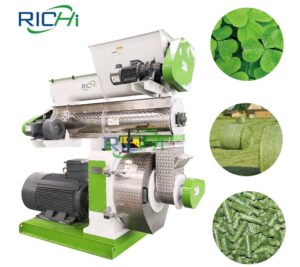
For example, a small flat-die pellet machine may be suitable for a farm that prepares its own feed. A larger ring-die pellet mill may be more appropriate for a commercial operation with continuous production requirements.
The difference becomes even larger when comparing a standalone pellet machine with a complete processing line. A standalone machine may only handle the pelletizing stage, while a complete line can include raw-material receiving, cleaning, crushing, batching, mixing, pelletizing, cooling, screening, conveying, and packing.
Therefore, when comparing the cattle feed pellet machine price, it is important to first define what the equipment is expected to do.
A lower initial equipment cost does not necessarily mean lower overall investment. If additional equipment has to be purchased later because the original machine cannot handle the required capacity, the final project cost may be considerably higher.
What Raw Materials Will Be Used?
Raw materials are one of the most important factors when designing a cattle feed processing system.
Common ingredients include corn, wheat bran, soybean meal, rice bran, alfalfa, grass meal, cottonseed meal, mineral additives, and other agricultural by-products. Different materials have different particle sizes, moisture levels, fiber contents, and physical properties.
Corn, for example, normally needs to be ground before mixing and pelletizing. Long-fiber materials such as hay or straw may require a different preparation process. High-moisture materials can also affect grinding efficiency and pellet formation.
This means the equipment configuration should be based on the actual formulation rather than the general category of “cattle feed.”
If the formula contains a large proportion of fibrous ingredients, the grinding and conditioning stages may require more attention. If the feed contains a high percentage of grains, the hammer mill may become one of the major pieces of equipment in the preparation section.
A good project therefore starts with a clear understanding of the raw materials available locally.
How Should Cattle Feed Ingredients Be Prepared?
Before pelletizing, raw materials usually need to be reduced to a suitable particle size.
Grinding improves the uniformity of the mixture and can make subsequent pellet formation more stable. However, excessively fine grinding is not always necessary. The ideal particle size depends on the animal, feed formula, pellet diameter, and equipment configuration.
For cattle feed, the target does not have to be identical to that used for poultry or pig feed. Ruminant diets can contain relatively high levels of fiber, and the physical structure of the feed also has nutritional significance.
A hammer mill is commonly used to process grains and other relatively dry materials. A pulverizer or specialized grinder may be considered for certain ingredients.
The selection of the grinding system affects both capital cost and electricity consumption. Oversized grinding equipment can increase the initial investment and may operate below its efficient range, while undersized equipment can become a production bottleneck.
Does Pellet Size Affect Equipment Selection?
Yes. Pellet diameter is another factor that should be considered before purchasing equipment.
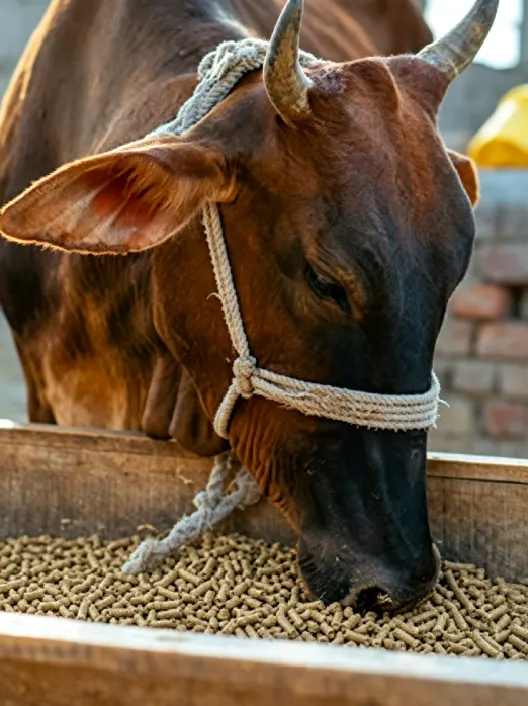
Cattle feed pellets can be produced in different diameters depending on the feed formula, animal age, feeding method, and customer requirements. A young calf may have different requirements from mature beef cattle.
The die determines the diameter of the finished pellets. Changing the die can therefore change the pellet specification without necessarily replacing the entire pellet mill.
However, pellet diameter also interacts with raw-material characteristics, moisture, compression ratio, and machine performance. A machine that performs well with one formulation may require different operating conditions for another.
This is why pellet size should be discussed during equipment selection rather than treated as an issue that can be solved after installation.
How Do I Know What Production Capacity I Need?
Capacity selection is often more important than the equipment’s nominal motor power.
Many new investors focus on the machine’s maximum output without considering how many hours per day the system will actually operate. A plant advertised as capable of producing a certain number of tons per hour may not need to run at that maximum continuously.
A better approach is to calculate the required daily production.
For example, if a farm needs 10 tons of feed per day and plans to operate the production system for five hours, the theoretical average requirement is about 2 tons per hour. In practice, additional time should be allowed for startup, cleaning, maintenance, material changes, and temporary interruptions.
This leads to a more practical question: what capacity livestock feed mill do I need?
Related Post: https://commercialpelletmill.com/livestock-feed-production-line/
The answer depends on daily demand, expected future growth, operating hours, storage capacity, and whether the feed is intended for internal use or commercial sale.
A small farm may not benefit from installing a large industrial line if its daily feed requirement is limited. Conversely, a commercial feed producer may find a small machine inefficient because production time becomes unnecessarily long.
Should You Choose a Small or Large Pellet Mill?
A small pellet mill is generally easier to install and requires less supporting infrastructure. It may be suitable for farms, cooperatives, small livestock operations, or businesses that are testing the market.
A larger system can offer higher production efficiency, but it usually requires more space, stronger electrical infrastructure, more conveying equipment, and greater investment in auxiliary machinery.
The correct choice is therefore not simply “small versus large.” It is a balance between present demand and future requirements.
If production is expected to increase significantly within a few years, it may make sense to reserve enough space and infrastructure for future expansion. At the same time, purchasing equipment far beyond the current production requirement can increase idle capacity.
A practical project should leave some room for growth without making future expansion the only consideration.
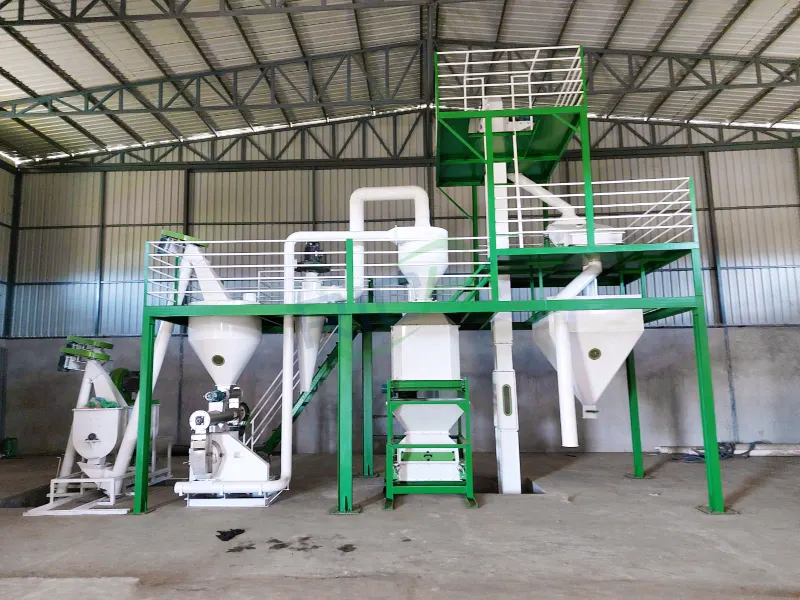
What Is Included in a Complete Processing Line?
A complete cattle feed processing system normally contains several stages.
The first is raw-material receiving and cleaning. Foreign materials such as stones, metal pieces, or other impurities need to be removed before further processing.
The second stage is grinding. Grain and other suitable ingredients are reduced to the required particle size.
The third stage is batching. Different ingredients are weighed according to the feed formula. Accurate batching is important because even small errors can change the nutritional composition of the finished feed.
After batching comes mixing. The objective is to distribute ingredients evenly throughout the mixture. Micro-ingredients such as minerals and additives require particular attention because they are usually included at relatively low inclusion rates.
The mixed feed then moves to the pelletizing section. Depending on the formulation and production requirements, conditioning with steam or another suitable treatment may be included.
After pelletizing, hot and moist pellets normally need to be cooled. Screening removes fines and separates material that does not meet the required size.
Finally, finished feed can be conveyed to bulk storage or sent to a packing machine.
Not every project requires all these stages. A farm that already has a grinder and mixer may only need the pelletizing section. A commercial feed factory, however, generally needs a more integrated process.
Does Moisture Matter During Pelletizing?
Moisture has a direct relationship with pellet formation.
If the material is too dry, pellets may have difficulty forming and can become fragile. If the material contains excessive moisture, the pelletizing process may become unstable and the finished product may require more intensive drying or cooling.
The ideal conditions vary according to the raw materials and formulation.
Steam conditioning is widely used in commercial feed production because it can improve material conditioning before compression. It may also influence pellet durability and production efficiency.
However, steam systems increase the complexity of the project. A small farm producing limited quantities may not need the same conditioning system as a large commercial plant.
The appropriate solution should therefore match the intended production scale.
How Does Automation Affect the Investment?
Automation is another major factor influencing project cost.
A basic system may rely on manual feeding, manual ingredient weighing, and simple controls. This can be reasonable for very small operations where labor is readily available.
A more advanced system may use automatic batching, centralized control, automatic ingredient dosing, sensor-based monitoring, and automated packing.
Automation can improve consistency and reduce manual work, but it also increases the initial investment and requires trained operators.
The right level of automation depends on production scale and labor conditions. There is little value in installing a highly sophisticated control system if the production volume is too small to justify it.
On the other hand, manual operation can become difficult to manage as the number of ingredients and production batches increases.
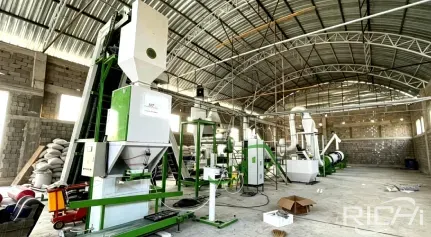
What About Electricity and Other Operating Costs?
Initial equipment investment is only one part of the economic picture.
Electricity consumption can become a significant operating expense, especially for grinding and pelletizing. Hammer mills, pellet mills, conveyors, fans, coolers, and other machines all contribute to total energy use.
Labor, spare parts, maintenance, lubrication, packaging materials, and raw-material handling should also be included in the operating budget.
For example, a pellet mill with a relatively low purchase cost may not necessarily provide the lowest long-term operating cost if its output is insufficient for the intended workload.
This is why a useful equipment comparison should consider both capital expenditure and operating efficiency.
How Should a New Feed Plant Be Laid Out?
Plant layout has a surprisingly large influence on project efficiency.
A logical material flow usually begins with raw-material receiving and storage, followed by cleaning, grinding, batching, mixing, pelletizing, cooling, screening, and finished-product storage.
The objective is to reduce unnecessary movement of materials and avoid crossing material flows.
Vertical layouts can make use of gravity to reduce conveying requirements. Horizontal layouts may be easier to construct in certain existing buildings.
The available land, building height, electricity supply, raw-material storage requirements, finished-feed storage, truck access, and future expansion plans should all be considered before construction begins.
A good layout also leaves sufficient space around major machines for inspection and maintenance.
What Questions Should Be Asked Before Requesting a Quotation?
A quotation is more useful when the project information is clearly defined.
At minimum, the equipment supplier should know the expected production capacity, feed type, main raw materials, pellet diameter, working hours per day, degree of automation, and available building conditions.
It is also useful to specify whether the project needs only a pellet mill or a complete processing system.
If several suppliers quote completely different configurations, comparing prices alone may lead to confusion. One quotation may include grinding, mixing, cooling, and packing, while another may only cover the pelletizing machine.
Therefore, the scope of supply should always be checked carefully.
Questions about installation, commissioning, spare parts, electrical requirements, and operator training can also help clarify the real project cost.
Can Existing Farm Equipment Be Reused?
In some projects, yes.
A farm may already have grain storage bins, conveyors, grinders, mixers, or packaging equipment. If these machines are still suitable for the new production capacity, they may be integrated into the upgraded system.
Reusing existing equipment can reduce capital expenditure, but compatibility should be checked first.
For example, an existing mixer may have a smaller batch capacity than the new pellet mill requires. In that case, the mixer could limit overall production.
Likewise, an old conveyor system may not be suitable for the required material flow.
A technical evaluation is therefore more useful than assuming that every existing machine can be reused.
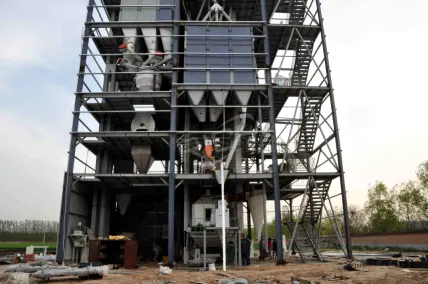
How Can Buyers Compare Equipment More Rationally?
The simplest approach is to compare projects according to the same technical scope.
Instead of asking only for the machine purchase cost, compare capacity, motor configuration, auxiliary equipment, automation, installation requirements, and expected operating conditions.
The same principle applies when researching manufacturers. Technical documentation, machine specifications, process diagrams, project experience, and after-sales arrangements can provide more useful information than promotional statements alone.
For additional equipment information and manufacturer background, readers can navigate to this site and review the available technical materials before deciding which specifications are relevant to their own project.
The purpose of this research stage is not necessarily to select a machine immediately. It is to establish a realistic technical and financial framework for the project.
What Role Does the Manufacturer Play?
The manufacturer can contribute more than the pellet mill itself, particularly when a project involves several interconnected machines.
A complete system requires coordination between grinding, batching, mixing, pelletizing, cooling, screening, conveying, and packaging. If the capacities of these machines are poorly matched, the nominal capacity of the pellet mill may not represent the actual production capacity of the plant.
For this reason, technical communication before ordering is important.
When evaluating a supplier such as pellet maker machine, it is useful to focus on the specific configuration being proposed rather than simply comparing company names.
The discussion should cover raw materials, production targets, pellet specifications, workshop dimensions, power supply, automation requirements, and installation conditions.
This approach makes it easier to understand why different projects can receive very different quotations even when they appear to produce the same type of feed.
Is the Cheapest Equipment Always the Most Economical?
Not necessarily.
A lower purchase price can be attractive, especially for a new business, but the equipment still needs to meet the required production target and product quality.
If a machine frequently operates at its maximum capacity, maintenance requirements may increase. If the cooling or screening system is undersized, production can be interrupted even though the pellet mill itself is working normally.
At the other extreme, excessive capacity can result in underutilized equipment and unnecessary capital investment.
The more useful question is therefore not “Which machine is cheapest?” but “Which configuration provides the required production capacity with a reasonable total cost of ownership?”
This perspective is particularly important for projects expected to operate for many years.
A Simple Way to Estimate the Total Project Budget
A preliminary budget can be divided into several categories.
1. Main processing equipment:
This includes grinders, mixers, pellet mills, coolers, screeners, and other core machines.
2. Conveying and storage:
Elevators, conveyors, bins, hoppers, and storage systems can account for a significant portion of the overall installation.
3. Electrical and control systems:
Motor control cabinets, sensors, cables, automation systems, and installation materials should be considered.
4. Building and infrastructure:
Construction, foundations, workshop modifications, ventilation, lighting, and utility connections may be required.
5. Installation and commissioning:
Depending on the project location and supplier arrangement, installation and commissioning can be separate from the equipment quotation.
6. Working capital:
Raw materials, packaging materials, spare parts, and initial operating expenses should also be included.
This broader calculation gives a much clearer picture than focusing exclusively on the pellet mill itself.
What Should a Small Cattle Feed Project Prioritize?
For a small farm or newly established operation, simplicity can be valuable.
The first priority should be reliable feed production rather than excessive automation or unnecessary equipment.
A basic system may consist of raw-material preparation, grinding, mixing, pelletizing, and simple handling equipment. If production increases later, cooling, screening, automatic batching, or packing systems can potentially be added.
The exact configuration depends on the feed formula and daily production requirements.
For a commercial project, the priorities may be different. Consistent batching, automated material handling, efficient cooling, dust control, and continuous production become increasingly important as capacity grows.
Final Thoughts: How Should You Approach Equipment Cost?
The cost of producing cattle feed pellets is influenced by much more than the pellet mill itself. Raw materials, capacity, pellet size, grinding requirements, mixing accuracy, moisture control, cooling, automation, workshop conditions, and future expansion all affect the final investment.
A sensible planning process therefore starts with the feed formula and daily production requirement. From there, the necessary processing stages can be identified and the equipment capacity can be matched to the actual workload.
Rather than selecting a machine based solely on a quoted number, it is better to compare complete technical configurations and estimate both initial investment and long-term operating costs.
In the end, the most useful equipment budget is one that reflects the real production process. Understanding that process first makes it much easier to interpret quotations, avoid unnecessary equipment, and build a feed production system that fits the scale of the operation.