The poultry industry has developed rapidly in recent years, and the demand for efficient feed production continues to increase. For poultry farmers and agricultural investors, feed quality is one of the most important factors affecting production efficiency, animal health, and overall profitability.
Feed is not simply a source of nutrition. It determines growth speed, feed conversion efficiency, egg production, and the economic performance of poultry farms. Therefore, more businesses are investing in professional feed processing facilities instead of depending entirely on external suppliers.
A modern feed pellet production line provides an effective solution for producing high-quality poultry feed with consistent nutritional value. By integrating crushing, mixing, pelletizing, cooling, screening, and packaging processes, businesses can establish a complete production system that meets their specific requirements.
Why Poultry Businesses Are Investing in Their Own Feed Production
For many poultry farms, purchasing finished feed from the market appears convenient. However, long-term dependence on commercial feed suppliers can create several challenges.
The biggest issue is cost uncertainty. Feed prices are influenced by grain markets, transportation expenses, and seasonal supply changes. When costs increase, poultry producers often have limited options to reduce expenses.
Producing feed independently provides greater control over the entire process. Farmers can select suitable raw materials, adjust formulas, and optimize production according to their own requirements.
The major advantages include:
- More stable feed supply
- Better control of production costs
- Flexible feed formulation
- Reduced transportation expenses
- Improved farm independence
For expanding poultry enterprises, establishing an efficient feed factory can become a valuable long-term investment.
Understanding Different Feed Factory Capacities
Choosing the correct production capacity is one of the most important decisions before investing in equipment. A factory that is too small may not satisfy future demand, while excessive capacity may increase unnecessary investment costs.
The appropriate solution depends on:
- Current poultry population
- Expected business growth
- Local market demand
- Raw material availability
- Investment budget
For medium-scale poultry businesses, a 5-6 T/H chicken feed manufacturing plant for sale can provide a balanced solution between investment and output.
This type of production system is suitable for companies that need stable daily feed production while maintaining efficient operating costs. It can support commercial poultry farms, regional feed suppliers, and agricultural enterprises.
Larger projects may require customized solutions with higher automation levels and expanded production capabilities. Meanwhile, smaller farms can choose compact systems according to their actual needs.
The Complete Process Behind High-Quality Poultry Feed
A professional feed factory includes multiple processing stages. Each stage contributes to the final quality of the feed product.
Raw Material Preparation
The first step is preparing ingredients for production. Common poultry feed materials include:
- Corn
- Wheat
- Soybean meal
- Rice bran
- Fish meal
- Mineral supplements
- Vitamins
Different ingredients have different characteristics, so proper preparation is necessary before entering the production process.
Grinding improves the uniformity of raw materials and creates suitable particle sizes for mixing and pellet formation.
Ingredient Mixing
After grinding, all ingredients are accurately mixed according to the feed formula.
Uniform mixing is essential because poultry requires balanced nutrition. If nutrients are unevenly distributed, some animals may receive insufficient nutrition while others receive excessive amounts.
Modern mixing equipment improves consistency and helps maintain stable feed quality between different production batches.
Pelletizing Process
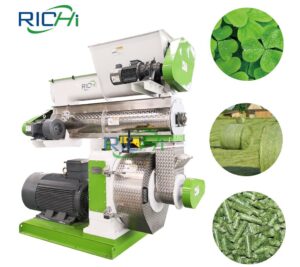
The pelletizing stage transforms mixed materials into compact feed particles. During this process, pressure and temperature help bind ingredients together.
A reliable pellet maker helps produce pellets with:
- Uniform size
- Good durability
- Reduced powder content
- Improved storage performance
Pellet feed is widely used in poultry farming because it reduces feed waste and improves feeding convenience.
Cooling and Screening
After pellet formation, the temperature of newly produced pellets is relatively high. Cooling equipment reduces temperature and removes excess moisture.
Screening equipment separates qualified pellets from broken particles and returns unsuitable materials for further processing.
This ensures that the final product maintains consistent quality.
(Related Post: https://www.richipelletmill.com/animal-feed-mill-equipment-for-sale/)
Packaging and Storage
The final step is packaging. Proper packaging protects feed from moisture, contamination, and quality loss during storage.
Efficient packaging systems also improve transportation and inventory management.
Key Factors for Building a Successful Feed Factory
Many investors focus mainly on machinery prices when planning a feed project. However, successful operation depends on much more than equipment cost.
Several important factors should be considered.
Raw Material Conditions
The availability and price of raw materials directly influence production costs.
A factory located near agricultural production areas usually has advantages because transportation costs are lower.
Production Efficiency
High production efficiency means better use of energy, labor, and equipment.
Optimized production processes reduce downtime and improve overall profitability.
Equipment Reliability
Feed factories often operate for many hours every day. Reliable equipment reduces unexpected shutdowns and maintenance expenses.
Technical Support
Professional technical guidance helps businesses solve installation, operation, and maintenance problems.
Experienced suppliers can provide customized recommendations based on project requirements.
Automation and Smart Management in Modern Feed Factories
The feed manufacturing industry is moving toward higher levels of automation. As labor costs increase and production requirements become more complex, intelligent management systems are becoming increasingly important.
Traditional factories often depend heavily on manual operation. This can lead to inconsistent production quality, higher labor requirements, and difficulties in monitoring performance.
Modern automated systems improve production management through:
- Automatic ingredient weighing
- Centralized equipment control
- Real-time production monitoring
- Data recording and analysis
- Automatic fault warnings
These technologies allow operators to manage production more efficiently while maintaining stable product quality.
For large poultry operations, automation is especially valuable because even small improvements in efficiency can create significant economic benefits over time.
How Feed Production Supports Poultry Farm Expansion
As poultry farms grow, feed demand increases rapidly. Many businesses face challenges when their existing feed supply cannot support expansion plans.
Building an independent production facility provides greater flexibility. Instead of adjusting farm growth according to external feed availability, companies can control production according to actual demand.
For example, a poultry enterprise may start with a medium-capacity factory and gradually expand as market demand increases. This approach allows businesses to control investment risks while preparing for future growth.
A well-designed feed factory can support:
- Broiler farms
- Layer farms
- Breeding farms
- Integrated agricultural enterprises
- Commercial feed suppliers
This flexibility makes feed production an important part of modern agricultural development.
Improving Feed Quality Through Better Production Management
Feed quality depends not only on raw materials but also on production management.
Several factors influence the final product:
Formula Accuracy
A balanced formula ensures animals receive the correct nutrients. Advanced production systems help maintain accurate ingredient ratios.
Processing Conditions
Temperature, moisture level, and pressure during pellet production influence pellet quality.
Equipment Maintenance
Regular inspection and maintenance help maintain stable machine performance.
Quality Control
Testing raw materials and finished products helps identify problems early.
A professional feed factory combines advanced equipment with effective management practices to achieve consistent results.
Environmental Benefits of Modern Feed Processing
Sustainable agriculture is becoming a global priority. Modern feed factories contribute to environmental protection by improving resource utilization.
Efficient processing reduces material waste and allows agricultural by-products to be reused.
Examples include:
- Utilizing grain processing residues
- Reducing transportation requirements
- Improving energy efficiency
- Minimizing production waste
These improvements help businesses reduce operating costs while supporting more sustainable agricultural practices.
Common Mistakes When Planning a Feed Production Project
Many new investors encounter difficulties because they underestimate the complexity of feed factory planning.
Several common mistakes include:
Choosing Equipment Without Considering Production Goals
Different businesses require different solutions. Equipment should match actual output requirements rather than simply focusing on price.
Ignoring Future Expansion
A factory designed only for current demand may become insufficient when the business grows.
Poor Factory Layout Planning
An inefficient layout can increase material handling costs and reduce production efficiency.
Lack of Technical Preparation
Proper installation, employee training, and maintenance planning are essential for stable operation.
Working with experienced professionals helps avoid these problems and improves the success rate of a project.
The Importance of Professional Feed Factory Solutions
Every agricultural business has unique requirements. A small family farm and a large commercial poultry company cannot use the same production strategy.
A professional project evaluation should consider:
- Production capacity
- Feed types
- Raw materials
- Factory location
- Automation requirements
- Investment expectations
Customized solutions provide better results because they are designed around actual business conditions.
When researching different equipment options and industry information, investors can look at this website to understand more about modern feed manufacturing technology and production concepts.
Future Trends in Poultry Feed Manufacturing
The future of poultry feed production will focus on efficiency, intelligence, and sustainability.
Several important trends are expected:
Increased Automation
More factories will adopt automated control systems to improve production accuracy and reduce labor dependence.
Customized Nutrition
Feed formulas will become more specialized according to animal breeds, growth stages, and regional conditions.
Better Resource Utilization
More agricultural by-products will be processed into valuable feed ingredients.
Digital Factory Management
Data-based management systems will help businesses improve decision-making and production efficiency.
These developments will create new opportunities for agricultural enterprises that invest in modern production systems.
Conclusion
A successful poultry business requires more than quality breeding techniques. Efficient feed management is equally important because feed directly influences production costs and animal performance.
Investing in a suitable feed manufacturing system allows businesses to achieve better control over nutrition, supply stability, and operational expenses.
From small farms to large commercial enterprises, selecting the right production capacity, reliable equipment, and professional planning strategy is essential.
A modern feed factory is not only a place where feed is produced. It is a strategic investment that helps agricultural businesses improve competitiveness, reduce risks, and prepare for future growth.
As the global demand for poultry products continues to increase, efficient feed production technology will remain a key foundation for sustainable farming development.